#ContactForm1 { display:none !important; }

Wh questions

Wh- Questions allow a speaker to find out more information about topics. They are as follows:
    When?Where?
    Who?
    Why?
    How?
    What?
    TimePlace
    Person
    Reason
    Manner
    Object/Idea/Action

      Other words can also be used to inquire about specific information:
      Which (one)?Whose?
      Whom?
      How much?
      How many?
      How long?
      How often?
      How far?
      What kind (of)?
      Choice of alternativesPossession
      Person (objective formal)
      Price, amount (non-count)
      Quantity (count)
      Duration
      Frequency
      Distance
      Description


      The “grammar” used with wh- questions depends on whether the topic being asked about is the “subject” or “predicate” of a sentence. For the subject pattern, simply replace the person or thing being asked about with the appropriate wh-word.
        (Someone has my baseball.)(Something is bothering you.)Who has my baseball?What is bothering you?

      Hasil gambar untuk questions

      For the predicate pattern, wh- question formation depends on whether there is an “auxiliary” verb in the original sentence. Auxiliary or “helping” verbs are verbs that precede main verbs. Auxiliary verbs are italicized in the following sentences.
        can do it.
        They are leaving.
        have eaten my lunch.
        should have finished my homework.
      To make a question using the predicate pattern, first form a yes/no question by inverting the subject and (first) auxiliary verb. Then, add the appropriate wh- word to the beginning of the sentence.
        (You will leave some time.)… will you leave
        When will you leave?
        (He is doing something.)… is he doing
        What is he doing?
        (They have been somewhere.)… have they been
        Where have they been?
      If there is no auxiliary and the verb is “be,” invert the subject and verb, then add the appropriate wh- word to the beginning of the sentence.
        (He is someone.)… is he
        Who is he?
        (The meeting was some time)… was the meeting
        When was the meeting?
      If there is no auxiliary and the verb is not “be,” add do to the beginning of the sentence. Then add the appropriate wh-question word. Be sure to “transfer” the tense and number from the main verb to the word do.
        (You want something.)… do you want
        What do you want?
        (You went somewhere.)… did you go (past tense)
        Where did you go?
        She likes something.)… does she like (third person –s)
        What does she like?

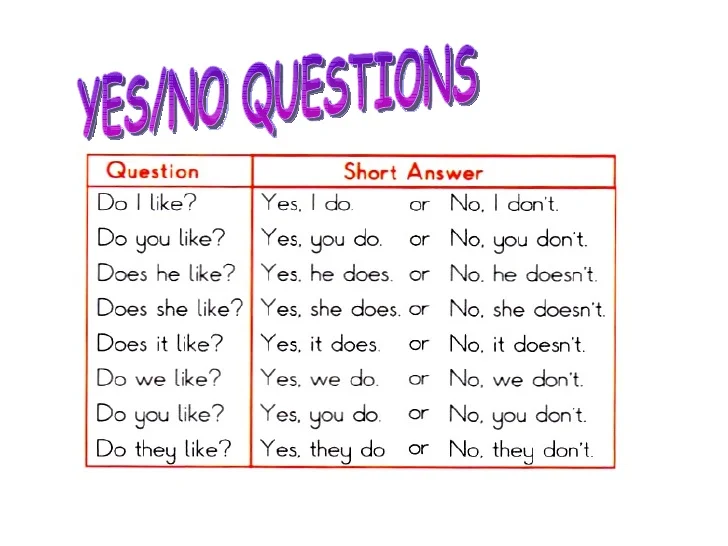
    Yes/No Questions

    There are many types of questions in English. The easiest are questions that can be answered “yes” or “no.”
      A: Are you from around here?
      B: Yes, I am. A: Do you come here often?
      B: Yes, I do. A: Can I buy you a drink?
      B: No, thanks. A: Are you married?
      B: Yes, I am.
    Hasil gambar untuk yes no question

    To form a question from a statement, first count the number of verbs.
      John is a doctor.One verb: is (be)
      Jane drives a sports car.One verb: drives
      Joan played basketball last night.One verb: played
      Jan is eating her dinner.Two verbs: is eating
      June has rented an apartment.Two verbs: has rented
      Jen has been living there since 1969.Three verbs: has been living

    If there is one verb in the statement and the verb is a form of be, simply switch the positions of the subject and verb.
      StatementQuestion
      John is a doctor.Is John a doctor?
      The Jensens are here.Are the Jensens here?

    If there are two verbs, simply switch the positions of the subject and first verb.
      StatementQuestion
      Jan is eating dinner.Is Jan eating dinner?
      June has rented an apartment.Has June rented an apartment?
      Jen has been living here since 1969.Has Jen been living here since 1969?
    If there is one verb, and the verb is not a form of be, the process is more complex.
    1. Add Do to the beginning of the sentence.
      The Johnsons live in that house.Do the Johnsons live in that house?

    2. If the main verb “carries” a third person singular s, move the s to Do, making it Does.
      Jane drives a car.Do Jane drives a car? (Not finished yet!)
      Does Jane drive a car? (Good question!)

    3. If the main verb “carries" past tense, move the past tense to Do, making it Did.
      Joan played basketball last night.Do Joan played basketball? (Not finished yet!)
      Did Joan play basketball? (Good question!)
    In conversation, most questions are asked of the second person (you) and answered in the first (I).
      A: Are you from California?
      B: No, I’m from Oregon. Are you?
      A: Yes, I’m from Hollywood.
      B: Do you know any movie stars?
      A: No, I don’t go out at night.
    In British English, the main verb have sometimes functions like be in questions. This is not common in American English.
      StatementQuestion
      You have a pet ferret.Have you a pet ferret? (British)
      Do you have a pet ferret? (American)

    Degree of Comparison

    Baca kalimat berikut yang menungjukkan degree of comparison:
    1. John is tall.
    2. Peter is taller than John.
    3. Harry is the tallest of the three.
    Dalam kalimat 1, kata sifat tall hanya mengatakan sesuatu tentang tinggi John, tnapa menyatakan seberapa tinggi John. Dalam kalimat 2, kata sifat lebih tinggi digunakan untuk membandingkan tinggi John dengan tinggi Peter.

    Dalam kalimat 3, kata sifat tertinggi digunakan untuk membandingkan tinggi Harry dengan tinggi John dan Peter.
    Kita telah melihat bahwa kata sifat berubah bentuk untuk menunjukkan perbandingan. Berbagai bentuk kata sifat ini disebut degrees of comparison.
    Dalam contoh yang diberikan di atas, kata sifat tall dikatakan dalam positive degree. Kata sifat taller dikatakan berada dalam comparative degree dan kata sifat the tallest dikatakan dalam superlative degree.
    Positive degree dari adjective adalah kata sifat dalam bentuknya yang sederhana, digunakan untuk menunjukkan keberadaan kualitas saja. Kata sifat dalam positive degree digunakan ketika tidak ada perbandingan yang dibuat.
    Comparative degree dari adjective menunjukkan tingkat kualitas yang lebih tinggi daripada yang ada pada positive degree, digunakan ketika dua hal atau dua set hal dibandingkan.
    • Peter is smarter than John.
    • Which of the two sisters is the prettier?
    • Apples are dearer than oranges.
    Superlative degree dari adjective menunjukkan tingkat kualitas tertinggi. Ini digunakan ketika lebih dari dua hal atau set hal dibandingkan.
    • Peter is the smartest boy in the class.
    • Iron is the most useful of all metals.
    • Alice is the prettiest girl in the neighborhood.
    Yuk, belajar bahasa Inggris lebih lanjut. Kelas private harga group.

    Adjectives without Nouns

    Adjectives without nouns sering juga digunakan. Adjective tanpa Noun mengacu pada well-known groups of people

    Struktur  the + adjective digunakan untuk berbicara tentang beberapa kelompok orang. Contohnya : the blind, the deaf, the unemployed, the rich, the poor, the young, the old, the dead etc.
    • He is collecting money for the blind. (= He is collecting money for blind people.)
    • Blessed are the meek.
    • The government should do something for the poor.
    Perhatikan bahwa ungkapan ini selalu jamak.. The blind mengacu pada all blind people. Demikian pula, the dead mengacu pada all dead people. Adjectives yang umum biasanya digunakan tanpa the.
    Blessed are the meek. (NOT Blessed are meek.)
    Ekspresi ini tidak dapat digunakan dengan possessive ‘s.
    The problems of the blind should be properly addressed. OR Blind people’s problems should be properly addressed. (NOT The blind’s problems should be properly addressed.)
    Dalam beberapa frasa tetap, the + adjective dapat memiliki makna tunggal. Contohnya: the accused, the former, the latter, the deceased etc.
    • The accused was released on bail.
    Perhatikan bahwa makna jamak juga dimungkinkan.
    Abstract ideas 
    Adjective dapat juga digunakan setelah the untuk merujuk pada beberapa kualitas atau ide abstrak.  
    Yuk, belajar bahasa Inggris lebih lanjut. Kelas private harga group.

    Adjectives

    Contoh adjective (kata sifat) kind, happy, smart dan intelligent. Adjective (Kata sifat) biasanya memodifikasi kata benda dan menunjukkan kualitas sementara atau permanen yang terkait dengan kata benda itu. Misalnya, a smart boy. Smart disini merupakan adjective (kata sifat) yang menjelaskan kualitas dari boy (anak laki-laki).
    Tidak semua kata sifat digunakan untuk menunjukkan kualitas yang terkait dengan kata benda. Misalnya, adjective mere dalam ‘a mere child’ tidak menunjukkan kualitas dari kata benda child.

    Jenis-jenis adjectives
    Adjectives bisa dibagi dalam beberapa kelompok:
    Adjectives of quality
    Kata sifat kualitas (adjectives of quality) mengacu pada jenis atau kualitas seseorang atau sesuatu. Adjective ini menjawab pertanyaan: "jenis apa?"
    • Tokyo is a large city. (Disini adjective menunjukkan kualitas tertentu yang berkaitan dengan kota Tokyo.)
    • Alice is a brilliant student. (Disini adjective menunjukkan kualitas tertentu yang berkaitan dengan kata benda Alice.)
    Perhatikan bahwa kata sifat yang dibentuk dari Proper Noun umumnya dianggap sebagai kata sifat kualitas. Contohnya: Persian carpets, French wines etc.
    Adjectives of quantity
    Adjectives of quantity menjawab pertanyaan ‘berapa banyak?’. Contohnya: some, any, much, little, enough, all, no, half, whole, etc.
    • We need some rice.
    • You have little patience.
    • He has lost all his wealth
    • He did not eat any rice.
    Adjectives of number
    Adjectives of number menjawab pertanyaan 'berapa banyak'. Contohnya: many, one, two, first, tenth, all etc.
    • Each hand has five fingers.
    • Sunday is the first day of the week.
    • All men must die.
    • There are several mistakes in your essay.
    Demonstrative adjectives
    Demonstrative adjectives menjawab pertanyaan ‘yang mana?’. Contohnya: this, that, these, those and such.
    • That boy is industrious.
    • This bag is made of expensive leather.
    • Those mangoes were very sweet.
    • I hate such people.
    Perhatikan this dan that digunakan dengan singular nouns. These dan those digunakan dengan plural nouns.
    Interrogative adjectives
    Ketika digunakan bersamaan dengan Noun untuk mengajukan pertanyaan, Kata tanya.what, which dan whose disebut interrogative adjectives.
    • Whose bag is this?
    • Which way shall we go?
    Yuk, belajar bahasa Inggris lebih lanjut.  Kelas private harga group.

    Auxiliary Verbs

    Auxiliary verbs merupakan kata kerja bantu yang berfungsi untuk membantu kata kerja ketika berubah wujud, misalkan dari kalimat positif ke kalimat pertanyaan atau dari kata kerja present (masa sekarang) ke past (masa lampau), dll. Yang termasuk dalam auxiliary verbs adalah sebagai berikut:
    • Is, am, are, was, were
    • Has, have, had
    • Do, does, did
    • Will, would; shall, should; can, could; may, might; must, ought, need, dare, used

    Beberapa dari auxiliary verbs bisa juga digunakan sebagai principal verbs (kata kerja utama). Seperti sudah disebutkan sebelumnya fungsi dari auxiliaries adalah membantu principal verbs dalam membentuk tense dan mood. Auxiliary verb juga mempunyai fungsi lainnya.
    Dalam bahasa Inggris kalimat yang menunjukkan kegiatan dimasa lampau menggunakan kata kerja bentuk lampau (past tense).  Untuk kata kerja yang beraturan (regular verbs) bentuk kata kerja masa lampau dengan adalah dengan menambahkan akhiran -ed, -d atau -t namun jika kalimat berubah menjadi bentuk negatif, maka diperlukan auxiliary verbs yang diikuti dengan not yang bisa disingkat menggunakan contraction n't.
    • It isn’t true. (= It is not true.)
    • We aren’t going anywhere. (= We are not going anywhere.)
    • You shouldn’t do that.
    • I don’t know what to do.
    Kegunaan dari auxiliary verbs
    Untuk membentuk kalimat negatif (negative sentences)
    • know him.
    • don’t know him. (BUKAN I know not him.)
    • She wrote to me.
    • She didn’t write to me. (BUKAN She wrote not to me.)
    Fungi dari do dan did membantu pernyataan positif menjadi pernyataan negatif. 
    Yuk, belajar dan berlatih Bahasa Inggris lebih lanjut.

    Verb Patterns

    Verbs (kata kerja) bahasa Inggris mempunyai beberapa pola yang disebut dengan istilah verb patterns
    Transitive verb adalah kata kerja yang mempunyai object. Susunan kata-kata pada umumnya dalam kalimat bahasa Inggris adalah subject + verb + object (subjek + kata kerja + objek)
    • Alice likes sweets. (Subject – Alice, Verb – likes, Object – sweets)
    • The principal punished the boy. (Subject – principal, Verb – punished, Object – boy)
    • The monk burned himself. (Subject – monk, Verb – burned, Object – himself)
    Alice likes …what? Sweets
    The principal punished …whom? The boy
    Jawaban atas pertanyaan what atau whom disebut direct object (objek langsung). Perhatikan juga penggunaan reflexive pronoun (e.g. myself, himself, herself, themselves etc.) sebagai object pada contoh kalimat ketiga diatas.
    Beberapa verbs diikuti oleh adverb particles. Sebagai contoh: put on, take off, give away, bring up, call in etc. Kadang-kadang particle nya terpisah dariverb dan diletakkan sesudah object.
    • He threw it away.
    • They called the visitor in.
    • He put his coat on.
    • His grandmother brought him up.
    • You must send it back.
    Perhatikan pada contoh diatas, particle nya diletakkan sesudah object jika object nya merupakan personal pronoun (kata ganti orang) atau bila object berupa kata pendek.
    Perbedaan antara adverb particle dan preposition yaitu particle berdekatan dengan kata kerjanya (verb) sedangkan  preposition berdekatan dengan noun atau pronoun yang mengaturnya. Adverb particle berikut ini tidak pernah berperan sebagai preposition – away, back, out, backward, forward, upward, downward dll. Namun on, off, in, up, down, to, from dll., bisa berperan sebagai particles dan prepositions.
    Kalau object nya panjang atau bila mau ditekankan maka adverb particle diletakan sebelum object.
    • The chief guest gave away the prizes.
    • He put on an air of innocence.
    • The sailors put out the fire in the hold of the ship.
    • We will not throw away anything useful.

    Verbs

    Apa itu verbs?  Verbs diterjemahkan sebagai kata kerja.
    Perhatikan contoh kalimat dibawah ini: 
    • Mother cooks dinner.
    • Children play in the park.
    • Barking dogs seldom bite.

    Dalam kalimat yang diberikan di atas, kata-kata yang ditulis tebal digunakan untuk menyatakan sesuatu tentang seseorang atau sesuatu. Mereka menyatakan apa yang dilakukan seseorang atau sesuatu. Kata-kata ini disebut kata kerja. 
    Sekarang baca kalimat berikut.
    • We have two hands and two legs. 
    • She is a good girl. 
    Di sini kata kerja have  dan is   menunjukkan apa yang dimiliki atau dilakukan seseorang. Kata-kata ini juga disebut kata kerja. Jadi kita telah melihat bahwa kata kerja adalah kata yang menunjukkan apa yang dimiliki atau dilakukan seseorang atau benda. Kata kerjanya juga dapat mengungkapkan apa yang terjadi atau dilakukan terhadap orang atau benda itu.
    The thief was beaten. (Kata kerja was beaten menyatakan apa yang terjadi pada pencuri)
     Satu kata kerja bisa lebih dari satu kata. Ada kata kerja yang terdiri dari empat kata.
    • It is raining.
    • It has been raining.
    • It rains.
    Transitive dan intransitive verbs
    Kata kerja yang mempunyai objek disebut transitive verbs.
    • She heard a noise. (subject – she, verb – heard, object – a noise)
    • He saw a pigeon. (Subject – he, verb – saw, object – a pigeon)
    • The girl  plucked the flower. (Subject – the girl, verb – plucked, object – the flower)
    • The master beat the dog. (subject – the master, verb – beat, object – the dog)
    Beberapa kata kerja tidak diikuti objek, disebut intransitive verbs. Contoh kata kerja intransitive: smile, sit, sleep, cry, laugh, dance dll.
    • The baby smiled. (Kata kerja smiled merupakan intransitive karena tidak ada objek.)
    • The child cried. (Kata kerja cried, intransitive karena tidak ada object.)
    • He sat on the bed. (Kata kerja sat, intransitive karena tidak ada object.)
    Semua kata kerja bisa bersifat transitif dan intransitif tergantung ada tidaknya objek yang mengikutinya.

    Yuk, belajar bahasa Inggris lebih lanjut.