#ContactForm1 { display:none !important; }

Wh questions

Wh- Questions allow a speaker to find out more information about topics. They are as follows:
    When?Where?
    Who?
    Why?
    How?
    What?
    TimePlace
    Person
    Reason
    Manner
    Object/Idea/Action

      Other words can also be used to inquire about specific information:
      Which (one)?Whose?
      Whom?
      How much?
      How many?
      How long?
      How often?
      How far?
      What kind (of)?
      Choice of alternativesPossession
      Person (objective formal)
      Price, amount (non-count)
      Quantity (count)
      Duration
      Frequency
      Distance
      Description


      The “grammar” used with wh- questions depends on whether the topic being asked about is the “subject” or “predicate” of a sentence. For the subject pattern, simply replace the person or thing being asked about with the appropriate wh-word.
        (Someone has my baseball.)(Something is bothering you.)Who has my baseball?What is bothering you?

      Hasil gambar untuk questions

      For the predicate pattern, wh- question formation depends on whether there is an “auxiliary” verb in the original sentence. Auxiliary or “helping” verbs are verbs that precede main verbs. Auxiliary verbs are italicized in the following sentences.
        can do it.
        They are leaving.
        have eaten my lunch.
        should have finished my homework.
      To make a question using the predicate pattern, first form a yes/no question by inverting the subject and (first) auxiliary verb. Then, add the appropriate wh- word to the beginning of the sentence.
        (You will leave some time.)… will you leave
        When will you leave?
        (He is doing something.)… is he doing
        What is he doing?
        (They have been somewhere.)… have they been
        Where have they been?
      If there is no auxiliary and the verb is “be,” invert the subject and verb, then add the appropriate wh- word to the beginning of the sentence.
        (He is someone.)… is he
        Who is he?
        (The meeting was some time)… was the meeting
        When was the meeting?
      If there is no auxiliary and the verb is not “be,” add do to the beginning of the sentence. Then add the appropriate wh-question word. Be sure to “transfer” the tense and number from the main verb to the word do.
        (You want something.)… do you want
        What do you want?
        (You went somewhere.)… did you go (past tense)
        Where did you go?
        She likes something.)… does she like (third person –s)
        What does she like?

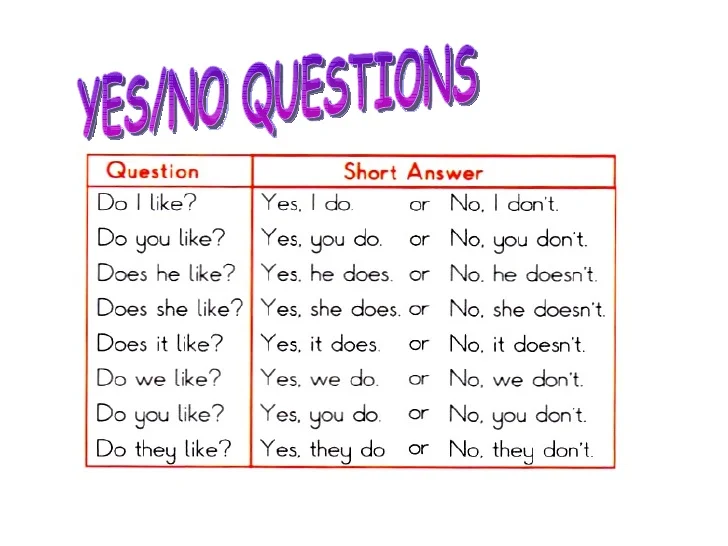
    Yes/No Questions

    There are many types of questions in English. The easiest are questions that can be answered “yes” or “no.”
      A: Are you from around here?
      B: Yes, I am. A: Do you come here often?
      B: Yes, I do. A: Can I buy you a drink?
      B: No, thanks. A: Are you married?
      B: Yes, I am.
    Hasil gambar untuk yes no question

    To form a question from a statement, first count the number of verbs.
      John is a doctor.One verb: is (be)
      Jane drives a sports car.One verb: drives
      Joan played basketball last night.One verb: played
      Jan is eating her dinner.Two verbs: is eating
      June has rented an apartment.Two verbs: has rented
      Jen has been living there since 1969.Three verbs: has been living

    If there is one verb in the statement and the verb is a form of be, simply switch the positions of the subject and verb.
      StatementQuestion
      John is a doctor.Is John a doctor?
      The Jensens are here.Are the Jensens here?

    If there are two verbs, simply switch the positions of the subject and first verb.
      StatementQuestion
      Jan is eating dinner.Is Jan eating dinner?
      June has rented an apartment.Has June rented an apartment?
      Jen has been living here since 1969.Has Jen been living here since 1969?
    If there is one verb, and the verb is not a form of be, the process is more complex.
    1. Add Do to the beginning of the sentence.
      The Johnsons live in that house.Do the Johnsons live in that house?

    2. If the main verb “carries” a third person singular s, move the s to Do, making it Does.
      Jane drives a car.Do Jane drives a car? (Not finished yet!)
      Does Jane drive a car? (Good question!)

    3. If the main verb “carries" past tense, move the past tense to Do, making it Did.
      Joan played basketball last night.Do Joan played basketball? (Not finished yet!)
      Did Joan play basketball? (Good question!)
    In conversation, most questions are asked of the second person (you) and answered in the first (I).
      A: Are you from California?
      B: No, I’m from Oregon. Are you?
      A: Yes, I’m from Hollywood.
      B: Do you know any movie stars?
      A: No, I don’t go out at night.
    In British English, the main verb have sometimes functions like be in questions. This is not common in American English.
      StatementQuestion
      You have a pet ferret.Have you a pet ferret? (British)
      Do you have a pet ferret? (American)